
Quobly highlights progress toward scalable silicon spin-qubit quantum computing at APS March Meeting
Mar 17, 2026
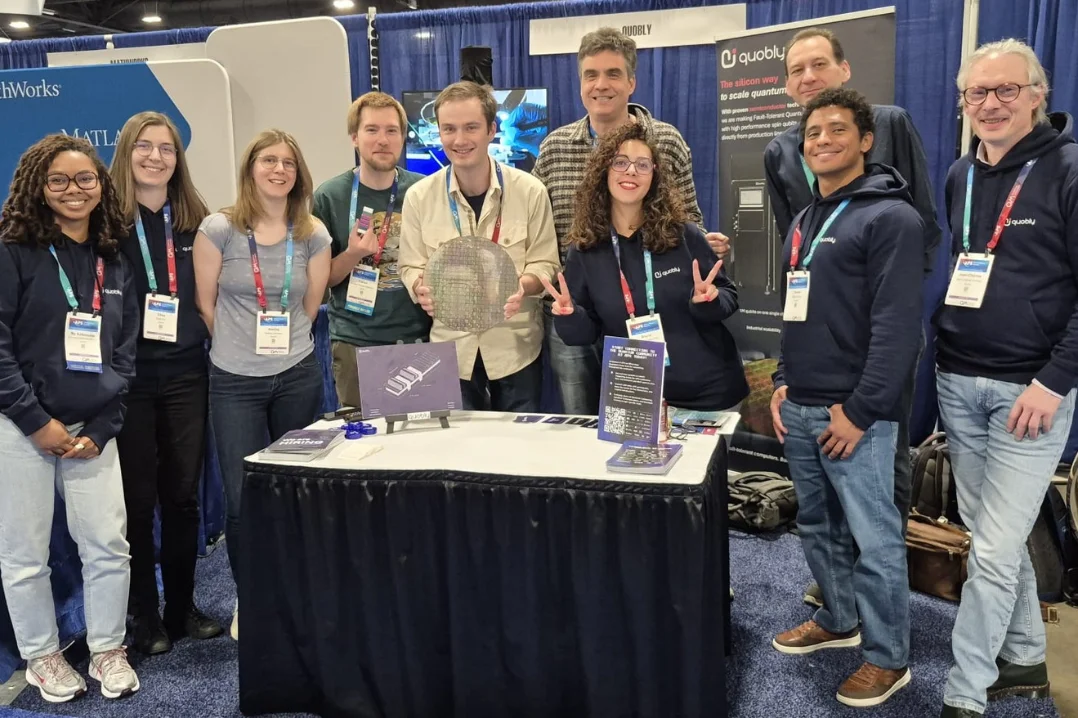
Quobly, a French pioneer in silicon-based quantum computing developing industrial-scale quantum processors based on silicon spin qubits manufactured with advanced semiconductor technology, is presenting several research contributions this week at the American Physical Society’s March Meeting in Denver, one of the world’s largest international conferences in physics.
Unlike many quantum computing platforms developed primarily in laboratory environments, Quobly’s approach leverages industrial CMOS semiconductor manufacturing technologies designed for large-scale chip production.
The results presented at APS reflect the different layers of the technology stack required to scale silicon quantum computing, spanning semiconductor devices, qubit calibration and control, realistic processor simulation, and quantum error correction research. Quobly develops quantum processors based on silicon spin qubits fabricated using fully depleted silicon-on-insulator (FD-SOI) technology on 300-millimeter wafers, enabling compatibility with commercial high-volume semiconductor manufacturing.
“Scaling quantum computing requires advances across the entire technology stack, from semiconductor devices to control, simulation and error correction,” said Tristan Meunier, co-founder and Chief Scientific Officer of Quobly. “Our approach builds on silicon technologies that already manufacture billions of chips every year, providing a realistic path to industrial-scale quantum processors. Our roadmap targets systems scaling to millions of qubits by 2032, designed to integrate with future high-performance computing and data-center infrastructures.”
Industrial silicon platform for spin qubits and control transistors
Several contributions focus on the operation and characterization of silicon spin qubits fabricated using fully depleted silicon-on-insulator (FD-SOI) technology on 300-mm wafers, forming the basis of Quobly’s QSOI® technology developed with STMicroelectronics. This industrial semiconductor approach enables both high-performance spin qubits and the integration of control transistors on the same chip, supporting scalable quantum processor architectures. These studies explore the cryogenic operation of FD-SOI quantum devices, the behavior of quantum dots in the few-electron regime, and wafer-level characterization of qubit devices fabricated using industrial CMOS processes. Automated extraction of device parameters from Coulomb-diamond measurements enables statistical analysis across large numbers of devices. Together, these results provide insights into the reproducibility and scalability of silicon spin qubits fabricated using industrial semiconductor manufacturing processes, an essential step toward large-scale quantum processors.
Automation and calibration for scalable qubit systems
A second focus addresses one of the major engineering challenges of quantum computing: the calibration and control of large numbers of qubits. Quobly researchers are developing graph-based calibration methods designed to automate the identification of qubit operating regimes and accelerate device tuning. Such automation will be essential for operating future quantum processors containing millions of qubits.
Simulation and benchmarking of spin-qubit processors
Alongside hardware development, Quobly is building tools to simulate and benchmark quantum processors based on realistic hardware models. These include SpinPulse, a digital twin of silicon spin qubits enabling noise-accurate simulations, pulse-level compilation workflows and benchmarking of quantum circuits. The framework integrates tensor-network techniques to support large scale simulations of quantum algorithms, including quantum phase estimation, widely studied for quantum chemistry applications.
The SpinPulse framework is described in a recent preprint (https://arxiv.org/pdf/2601.10435) and released as an open-source software library (https://quobly-sw.github.io/SpinPulse/).
Toward scalable fault-tolerant quantum processors
Taken together, these contributions illustrate Quobly’s system-level approach to silicon quantum computing, spanning semiconductor device physics, qubit control and calibration, realistic processor simulation, and quantum error-correction research. These advances contribute to the development of fault-tolerant quantum architectures, where quantum error correction enables reliable computation across large numbers of physical qubits.
Quobly’s product roadmap targets quantum processors scaling to millions of qubits by 2032, manufactured using industrial semiconductor infrastructure and designed to operate within future high- performance computing and data-center environments, supporting fault-tolerant applications such as optimization and scientific simulation.
This approach highlights how silicon quantum technologies developed within the semiconductor ecosystem could enable scalable quantum processors for future scientific and industrial applications.
Quobly contributions at the APS March Meeting
Industrial silicon spin-qubit devices
• Tangui Aladjidi – Frozen operation of FD-SOI quantum devices
• Bruna Cardoso Paz – 300-mm wafer-level characterization of quantum dots formed in industrial
CMOS qubit devices
• Elise Prin – Coulomb diamond analysis for wafer-level characterization of Si qubit devices
Automation and calibration
• Daniel Solis – Graph-based calibration for the control of silicon spin qubits
Simulation and benchmarking
• Valentin Savin – The SpinPulse library for the transpilation and noise-accurate simulation of spin-qubit
quantum computers
• Carlos Ramos Marimon – A Quantum Phase Estimation toolbox.
About Quobly
Quobly is a pioneer in quantum microelectronics, developing silicon-based quantum chips using proven semiconductor manufacturing processes. Founded in 2022 in Grenoble, France, the company builds on over 15 years of collaborative research between world-class institutions CEA-Leti and CNRS, combining expertise in quantum physics and microelectronics. Co-founded by Maud Vinet, Ph.D. in quantum physics, author of 300+ papers and 70+ patents, and Tristan Meunier, a leading expert in semiconductor quantum engineering trained under Nobel laureate Serge Haroche, Quobly bridges science and industry to make quantum computing scalable and manufacturable. The company has a strategic partnership with STMicroelectronics to accelerate the industrialization of its silicon quantum chips. In 2023, Quobly raised €19 million, a record European seed round for a quantum hardware startup, followed in 2025 by €21 million to advance its Q100T program, a key step toward fault-tolerant quantum computing. Quobly has offices in France, Singapore, and Canada. Follow us on LinkedIn.
Media contact: marie.cabrieres@quobly.io
Any questions?
Reach out to our communications team to receive more information and media resources.